An ode to IB (some mental musings on the goods and bads)
I made some of the best friends I will ever have.
I never got to see anyone who isn't in IB. Ever.
There is an IB family, because we are all in this together.
Anyone not in the program assumed we were some creepy cult.
I was challenged to think in ways I never had to before.
If I have to think up another knowledge question I might just die.
I can now write crazy long essays in crazy short amounts of time.
There were tears. Lots and lots of tears.
My knowledge of things in general has greatly increased.
It is often difficult to remember those things due to sleep deprivation.
My GPA looks awesome.
I got to listen to other people complain about not having an awesome GPA.
CAS forced me to get out there and try new things.
Building a snowman counts as CAS right?
I am now much more confident in vocalizing my opinions.
The oral exams nearly killed me.
Time management has become an essential part of life.
I still don't manage time and stress is a non-stop feeling.
TOK forced me to think outside the box.
What is the box? How do we know if we are every truly within the limits of it?
IB teachers are awesome.
Teachers actually hate us and assign all assignment to be due the same day.
It's only two years.
It's two very long years.
The IB program was one of the biggest decisions I've had to make in my short life (aside from choosing where to go to college). Even with all of the negatives to outweigh the positives, if I were given the choice to go back and make the decision again with the knowledge I have now, I would still choose it again. That does not by any means mean that I want to keep going, IB was cool but let's be real, I am so ready for college.
Sunday, April 19, 2015

Sunday, April 5, 2015
Whitman Writes What?
Walt Whitman, for all his brilliant musing and incredible ability to spin words, has very terrible handwriting. That might just be my own inability to read cursive speaking, but I blame the education system.


Looking at Whitman's notebook, what is there to see? The first thing that I noticed was his repeated use of the phrase "Ship of Libertad." It may not be relevant, but "libertad" means freedom in Spanish. The word also sounds quite a bit like the word liberty. He actually mentions ships more than once. "Ship of the world- Ship of humanity- Ship of the ages. (Ship that circles the world- ship of the hope of the world- ship of promise)." The different ships relate with the idea of connection across the world. Ships are vessels that travel the globe and Whitman might be trying to use this idea as a metaphor for connecting humans across the world as a symbol of hope or of unity. There is no way to know for sure what his intentions were by using "ship".

Later in his notebook, Whitman drew several pictures of men in profile. These could possibly be self portraits but either way they appear to progress. The first is just a face, the next is a face with a body, then the head gains a hat, and finally the figure is wearing what could be a uniform. The progression from a simple head that could be his own might indicate that Whitman has drawn inspiration from his own figure. He might have started with himself and then continued to change things until coming up with a new person. This could indicate that Whitman puts his own beliefs and opinions into his writing.
So those were some things that I noticed/interpreted. Now what did he really mean?
What I noticed about the use of the word "libertad" being Spanish was correct. It is also apparently a word that he uses commonly throughout many of his poems. The idea that I thought was connected to the ships, the idea of worldliness, is instead important in this word. He wants to portray the idea that freedom is not limited to any one country. The ships mean something slightly different than I had interpreted. They are in fact related to the idea of the succession of the south during the time of the civil war. Whitman shows some of his personal political beliefs by saying that the succession of the south could lead to harm of the government around the world.

The pictures of people that were drawn in the notebook were not actually drawn by Whitman. He apparently never drew pictures or doodled, so he had someone else do them. I was correct in assuming that the first one was a self portrait. The other pictures though are of people that he knew in his life. The pictures get progressively more cartoon like as they go on. I said before that It could be Whitman putting himself in his writing, but it appears to be more of him drawing inspiration for the people around him and adapting their images to fit his needs.
Talented poet or not, I am glad there were other people to interpret his handwriting for me.
Sunday, March 15, 2015
Yes We AmeriCAN!
Ah yes, the American Dream- The perfect life that everyone wants to live, but is also so perfect that actually achieving it is a dream of its own.
 Who wouldn't want to live the American Dream? It has adapted with the times but still has existed for the past hundred years. It has everything!
Unfortunately for most of us, in order to live the American Dream you have to be pretty dang wealthy. Being wealthy means having not just enough money to fulfill your needs, but also your wants, and sometimes the things you didn't even know you wanted.




- Graduating college with a degree and going straight into a high paying job
- Making tons of money without doing much actual work
- Finding the perfect significant other
- Having children with said significant other
- Living in a house with a white Pickett fence
- Happily growing old as your grandchildren take care of you until you die peacefully in your sleep
Unfortunately for most of us, in order to live the American Dream you have to be pretty dang wealthy. Being wealthy means having not just enough money to fulfill your needs, but also your wants, and sometimes the things you didn't even know you wanted.

You can be like this dude! After all money equals happiness right?
WRONG!
It's unfortunate that in our society people believe that in order to be happy you have to have expensive things and a perfect life. The truth is that as long as you are happy, does it really matter if you house has two bathrooms instead of three? Sadly, the commonly held belief the people who have less money have worse lives. Americans see the 1% as the high and mighty and the people living in poverty as the dregs of society.

I prefer to hold a different opinion than this one. I see it that in most cases you are in control of your own happiness. There are rich people who were born into their money, but there are also people who put in the hard work everyday to make a living. There are the poor people who waste all of their money on drugs, but there are also people who are just caught in a bad situation. No one has any right to judge a person based on the number in their bank account. Not everyone wants to live the American Dream. If someone chooses to live in a tent by the highway because it makes them happy, then more power to them.
After all, in the words of the East High students: We're all in this together!
Sunday, March 8, 2015
Sunday, February 15, 2015
You get to hear me talk this time
So here is me talking awkwardly:
And here is my planning if you want to look at it:

And here is my planning if you want to look at it:
And now I'm going to grade myself:
Knowledge and understanding of text- 7.5 (can you do that? I did)
I chose this because I think I did a fairly good job analyzing the text and using my understanding of the book as a whole, but I could have talked more about the message that the book is sending as a whole and the importance of this passage within the greater context.
Understanding and use of literary features- 7
While I looked at language, I mostly focused on word choice and could have done a better job of looking into other literary devices that the author used.
Organization- 4
While the structure that I chose is mostly coherent, It may not have been the best one for this passage. I stayed fairly consistent with the framework that I created.
Language- 4
I actually have no idea what makes my language good or not but I think I did a good job?
I had plenty of "ums" though and I repeated myself quite a bit.
Sunday, January 18, 2015
Once Upon a Blog Post
Once upon a blog post, I watched a Ted Talks.
This Ted Talk features Joe Sabia, an iPad storyteller, giving an overview of the progress that has been made in the technology of storytelling in the last 200 years. The author states that while the stories being told have remained largely unchanged, the methods of telling them have always been evolving. During the entire talk, Sabia is projecting his iPad screen to the audience and is continually changing apps and the images shown to help support his message. He uses pictures, text, and music to help tell his tale. He is representing a new style of storytelling by talking about storytelling. He begins with the description of a book and how it never changed until Lothar Meggendorfer from Germany created the first pop-up book. After this, methods of storytelling became more numerous and more creative. TV, movies, talk shows, and the internet are all just evolved forms of storytelling. He ends his presentation by taking a picture of the audience and putting them on the screen, indicating that they are a part of the story.


This Ted Talk features Joe Sabia, an iPad storyteller, giving an overview of the progress that has been made in the technology of storytelling in the last 200 years. The author states that while the stories being told have remained largely unchanged, the methods of telling them have always been evolving. During the entire talk, Sabia is projecting his iPad screen to the audience and is continually changing apps and the images shown to help support his message. He uses pictures, text, and music to help tell his tale. He is representing a new style of storytelling by talking about storytelling. He begins with the description of a book and how it never changed until Lothar Meggendorfer from Germany created the first pop-up book. After this, methods of storytelling became more numerous and more creative. TV, movies, talk shows, and the internet are all just evolved forms of storytelling. He ends his presentation by taking a picture of the audience and putting them on the screen, indicating that they are a part of the story.

The author's purpose in sharing this ted talks is to represent a new form of storytelling and giving a history of the progress that has been made in the art of storytelling. He is saying that even though what we are saying isn't changing, the way that we are saying it is. The ending implies that storytelling will continue to evolve past where we are now, as is its nature.
Joe Sabia is a storyteller, so his job is to (obviously) tell stories. This may make his argument seem less credible. The term storyteller is often associated with people who make things up or twist facts so that they suit their needs. This may make the author's message become somewhat misunderstood because of the stereotypes associated with his title. People will often assume that storytellers are making things up, not that they are retelling facts.
The author uses quite a bit of evidence to support his claim. He talks about and shows several different examples of the different ways that storytelling has advanced such as radio, TV, movies, internet, music, and more. The talk itself is framed as a story. It starts with the traditional Once upon a time and ends with a cliche and they all lived happily ever after. The presentation being framed as a story makes the author's argument pretty difficult to dispute. Because it is his job, it is possible that the author is bias in thinking that what he does is a true form of storytelling. Some people may believe that this unique method is too different to be truly considered a form of storytelling, and that would weaken the message that the author is trying to send.
The audience members are enthralled with this performance not only because the author continuously makes funny jokes that keep them interested and laughing, but he also makes the presentation easy to connect with. Sabia uses the visual of the iPad screen and many popular apps that can be used on it in order to tell him story. These are images that many people in this modern age see every day. The ideas are presented in a language that the audience understands and they will be more likely to agree because of it.
I found this talk very interesting. The art of storytelling and the stories that are being told has always been a topic that fascinates me. The author said in his presentation that the stories that we tell don't change and that relates directly to the idea of the hero's journey (see my extended essay for more details). The idea of being able to communicating these stories in different ways has also always been interesting. For my personal project I even did a project relating to picture books (hmm, I'm seeing a pattern here...). This seemed like a topic that was very relevant to the things that I am interested in and definitely caught my attention when I started to watch it.
As the blog post came to an end, I reflected on what I learned and, along with the other IB students, lived happily ever after (well after we graduate that is).
The End
Sunday, January 4, 2015
Double Indemnity? Double the Drama
Double Indemnity has been called “a film without a single trace of pity or love.” Do you agree with this statement? Think about the motivations that lie behind the actions of Walter Neff and Phyllis Dietrichson when you consider your response.
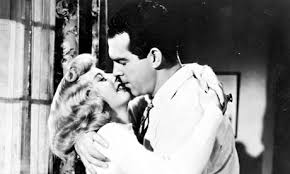
It is understandable where a person would get this idea, that this movie doesn't have a single trace of pity or love, but I disagree with that statement wholeheartedly. Love is seen in many different situations and between many different characters. Pity as well is an important emotion. These are sometimes the driving force for decisions made by different characters.
Let's take Walter Neff for example. More specifically, his relationship with Phyllis Dietrichson. The entire movie is based on a murder and insurance fraud that Walter was adamantly against until Phyllis convinced him to help her. Walter is immediately attracted to Phyllis when he first meets her, but it takes seeing her again for him to decided he cares enough about her that he want to help her out of an awful situation. You could argue that this is just a physical attraction. Phyllis used her beauty and feminine wiles to get what she wants (female privilege??). But isn't attraction what love is based off of? When you like something about a person, whether it be their looks, actions, or other traits, isn't that what makes a person initially fall in love? By the end it is clear that Walter doesn't love her (Spoiler: he kills her). I do believe that at the beginning of the movie Walter is in love, or is on his way to being in love, with Phyllis and that is why he went along with her plan.

Phyllis admits at the end of the movie that she never cared for Walter. She says she never loved him "until a minute ago, when I couldn't fire that second shot." She never says outright that she loves him but it is implied pretty heavily. She has to know that nothing good will happen to her unless Walter is dead, but she still can't bring herself to make the final shot. Phyllis' initial intentions were to manipulate Walter into helping her gain what she wanted, freedom fro her marriage and the money that she could get out of it. These stayed her intentions up until her final meeting with Walter where something changed. I don't know what did it, but in that moment Walter mattered more to her than the money and she couldn't shoot. This is just another plot point that is influenced by love. Whether or not that love was a good or bad thing is up to interpretation, but you can't say it's not there.
Dumbledore said it, and this quote could probably apply to several of the characters in this movie. Someone who has love, but is still pitied, is Lola, Phyllis' step-daughter. After Mr. Dietrichson was killed, Lola goes to Walter Neff because she wants to share her ideas that her step-mother was behind it. Neff Initially spends time with her to keep her from going to the police, but then he continues to see her because he feels bad about what she went through. Neff gets to know Lola because he pities her and he feels some guilt for what has happened. Neff's pity for Lola is very important for building his character and building the plot, so how could pity not exist?

The final example of love that I want to look at is a little bit different. It could be argued that it is one of the strongest types of love out there: Bro-love. I can't say I fully understand how it works, but I can recognize it, and Walter Neff and his partner Barton Keyes have it. It is not apparent at the beginning, but as we learn more about the characters it becomes more apparent. Close to the end of the movie, Neff listens to a recording that Keyes made and in it he stands up for Neff, claiming that they have been good friends for eleven years, and that's what bros do. The last lines of the movie walter is talking about the man who commited the murder (himself) and says that Keyes must have been surprised that the man had been right across the desk the whole time. Keyes responds with "He was closer than that" and Walter says "Love you too." Keyes stays with Walter to wait for the ambulance because even though Walter committed those crimes, Keyes is still his friend in a true bro fashion. This is not a romantic type of love but it is just as important, and very apparent in this story.
Many of the characters show love and pity to each other throughout this story, but those are not the main, overarching themes of the movie. The person who said the original quote may have been talking in reference to the message that the movie is sending or the mood that it creates, not individual character relationships. Although it is not one of our classic tales of romance, Double Indemnity certainly shows hints of love.
It is understandable where a person would get this idea, that this movie doesn't have a single trace of pity or love, but I disagree with that statement wholeheartedly. Love is seen in many different situations and between many different characters. Pity as well is an important emotion. These are sometimes the driving force for decisions made by different characters.
Let's take Walter Neff for example. More specifically, his relationship with Phyllis Dietrichson. The entire movie is based on a murder and insurance fraud that Walter was adamantly against until Phyllis convinced him to help her. Walter is immediately attracted to Phyllis when he first meets her, but it takes seeing her again for him to decided he cares enough about her that he want to help her out of an awful situation. You could argue that this is just a physical attraction. Phyllis used her beauty and feminine wiles to get what she wants (female privilege??). But isn't attraction what love is based off of? When you like something about a person, whether it be their looks, actions, or other traits, isn't that what makes a person initially fall in love? By the end it is clear that Walter doesn't love her (Spoiler: he kills her). I do believe that at the beginning of the movie Walter is in love, or is on his way to being in love, with Phyllis and that is why he went along with her plan.

Phyllis admits at the end of the movie that she never cared for Walter. She says she never loved him "until a minute ago, when I couldn't fire that second shot." She never says outright that she loves him but it is implied pretty heavily. She has to know that nothing good will happen to her unless Walter is dead, but she still can't bring herself to make the final shot. Phyllis' initial intentions were to manipulate Walter into helping her gain what she wanted, freedom fro her marriage and the money that she could get out of it. These stayed her intentions up until her final meeting with Walter where something changed. I don't know what did it, but in that moment Walter mattered more to her than the money and she couldn't shoot. This is just another plot point that is influenced by love. Whether or not that love was a good or bad thing is up to interpretation, but you can't say it's not there.
“Do not pity the dead Harry. Pity the living, and, above all, those who live without love.” -Albus Dumbledore
Dumbledore said it, and this quote could probably apply to several of the characters in this movie. Someone who has love, but is still pitied, is Lola, Phyllis' step-daughter. After Mr. Dietrichson was killed, Lola goes to Walter Neff because she wants to share her ideas that her step-mother was behind it. Neff Initially spends time with her to keep her from going to the police, but then he continues to see her because he feels bad about what she went through. Neff gets to know Lola because he pities her and he feels some guilt for what has happened. Neff's pity for Lola is very important for building his character and building the plot, so how could pity not exist?
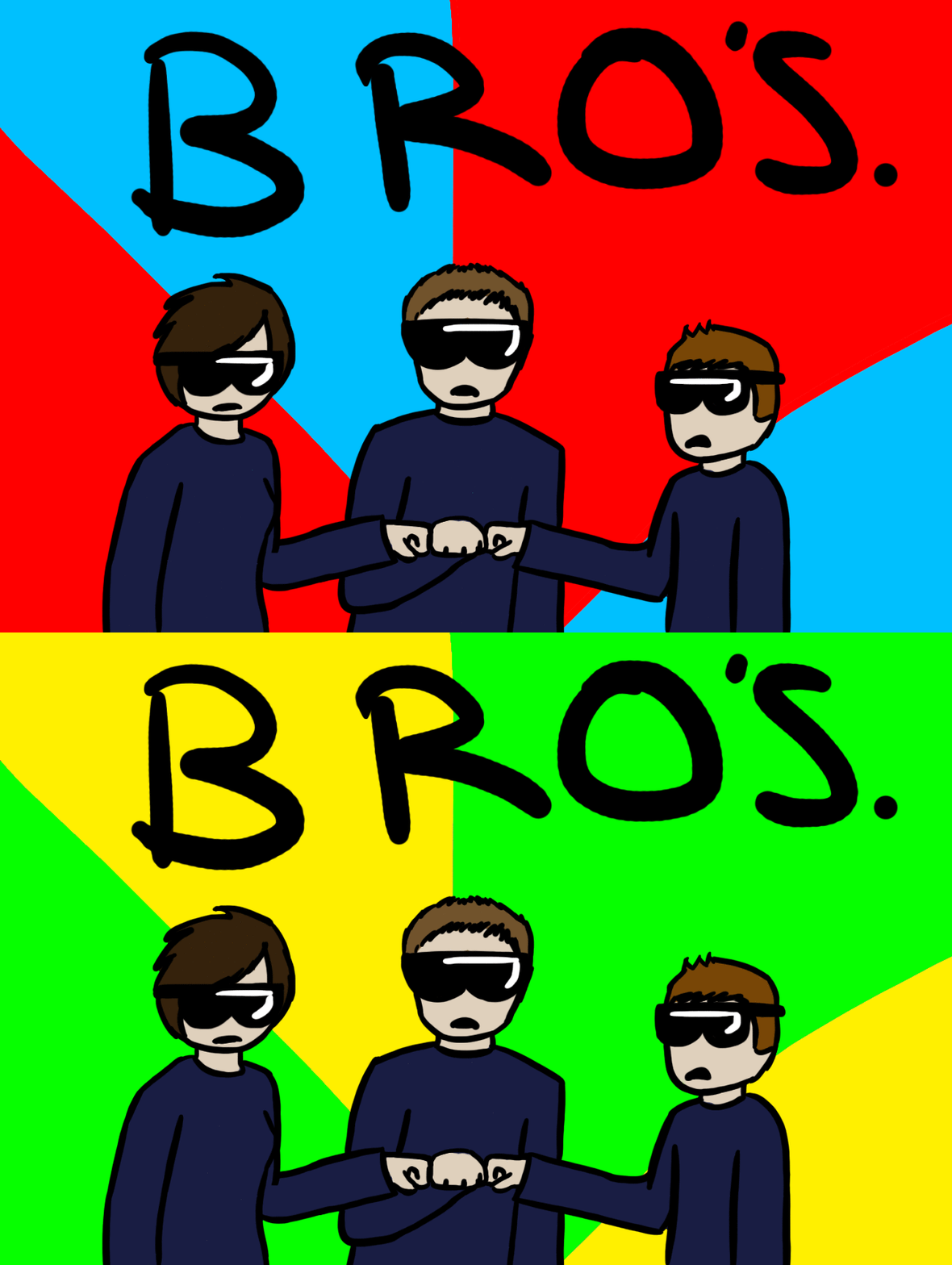
The final example of love that I want to look at is a little bit different. It could be argued that it is one of the strongest types of love out there: Bro-love. I can't say I fully understand how it works, but I can recognize it, and Walter Neff and his partner Barton Keyes have it. It is not apparent at the beginning, but as we learn more about the characters it becomes more apparent. Close to the end of the movie, Neff listens to a recording that Keyes made and in it he stands up for Neff, claiming that they have been good friends for eleven years, and that's what bros do. The last lines of the movie walter is talking about the man who commited the murder (himself) and says that Keyes must have been surprised that the man had been right across the desk the whole time. Keyes responds with "He was closer than that" and Walter says "Love you too." Keyes stays with Walter to wait for the ambulance because even though Walter committed those crimes, Keyes is still his friend in a true bro fashion. This is not a romantic type of love but it is just as important, and very apparent in this story.
Many of the characters show love and pity to each other throughout this story, but those are not the main, overarching themes of the movie. The person who said the original quote may have been talking in reference to the message that the movie is sending or the mood that it creates, not individual character relationships. Although it is not one of our classic tales of romance, Double Indemnity certainly shows hints of love.
Sunday, December 7, 2014
What'cha Watchin'?
Lady Macbeth may have been the Queen of Scotland, But she always made time for her Netflix shows when her King was busy. Some shows in particular were her favorites.
Orange is the New Black
Just because you are married doesn't mean you can't have some woman power! This show revolving around a woman who is sent to an all female prison stars some very strong female characters. Lady Macbeth is a very big believer in the woman being a strong force in a relationship, and what better inspiration than the dominant women shown in prison in this show. Lady Macbeth can also connect with the main character. Piper broke the law and tried to move on from it, but her past followed her. Lady Macbeth can relate to this and enjoy seeing someone else in the same shoes.
The Lion King
Lady Macbeth isn't much of a fan of animated films, too silly and childish, but this one speaks to her. Unlike most people who sympathize with Simba, Lady Macbeth connect much better with the character of Scar. Scar kills the much loved king in a bid for power and becomes successful. At the end of the movie Simba returns and defeats Scar in an epic battle. Lady Macbeth approves of Scar's actions in the beginning, sometimes there has to be death in order for a new era to begin, but sees the ending as unrealistic because no king would let their kingdom get that bad, and therefore no one would try to overthrow them, right? RIGHT?
Dexter
This show revolves around a blood splatter analyst working for the Miami Police Department who is also a serial killer. The main character only kills people who he think deserve it such as rapists and murderers. Lady Macbeth is a definite fan of this show. She can connect very well with a character who holds a respectable and high up position in society, but also accepts that killing is sometimes the best way to get what you want. Unfortunately for Lady Macbeth, every time she watches this show she has to wash her hands several times to get the image of blood splatters out of her mind.
Scandal
This show features another strong willed woman. Olivia Pope is a former government employee who is trying to leave behind a past that haunts her. This show is definitely appealing to Lady Macbeth because of its drama. The main character has to face her past coming back to haunt her and working as a woman in a world dominated by men. Lady Macbeth connects with this and loves seeing how Olivia deals with her problems. Perhaps it is the man troubles or the haunting past, Lady Macbeth is glued to the TV when this show is on.
There are surely more movies and TV shows that would appear on Lady Macbeth's favorites list, but these few are the ones she likes the best. Unfortunately for her, she can't stay hidden behind the TV screen forever!
Orange is the New Black
Just because you are married doesn't mean you can't have some woman power! This show revolving around a woman who is sent to an all female prison stars some very strong female characters. Lady Macbeth is a very big believer in the woman being a strong force in a relationship, and what better inspiration than the dominant women shown in prison in this show. Lady Macbeth can also connect with the main character. Piper broke the law and tried to move on from it, but her past followed her. Lady Macbeth can relate to this and enjoy seeing someone else in the same shoes.
The Lion King
Lady Macbeth isn't much of a fan of animated films, too silly and childish, but this one speaks to her. Unlike most people who sympathize with Simba, Lady Macbeth connect much better with the character of Scar. Scar kills the much loved king in a bid for power and becomes successful. At the end of the movie Simba returns and defeats Scar in an epic battle. Lady Macbeth approves of Scar's actions in the beginning, sometimes there has to be death in order for a new era to begin, but sees the ending as unrealistic because no king would let their kingdom get that bad, and therefore no one would try to overthrow them, right? RIGHT?
Dexter
This show revolves around a blood splatter analyst working for the Miami Police Department who is also a serial killer. The main character only kills people who he think deserve it such as rapists and murderers. Lady Macbeth is a definite fan of this show. She can connect very well with a character who holds a respectable and high up position in society, but also accepts that killing is sometimes the best way to get what you want. Unfortunately for Lady Macbeth, every time she watches this show she has to wash her hands several times to get the image of blood splatters out of her mind.
Scandal
This show features another strong willed woman. Olivia Pope is a former government employee who is trying to leave behind a past that haunts her. This show is definitely appealing to Lady Macbeth because of its drama. The main character has to face her past coming back to haunt her and working as a woman in a world dominated by men. Lady Macbeth connects with this and loves seeing how Olivia deals with her problems. Perhaps it is the man troubles or the haunting past, Lady Macbeth is glued to the TV when this show is on.
There are surely more movies and TV shows that would appear on Lady Macbeth's favorites list, but these few are the ones she likes the best. Unfortunately for her, she can't stay hidden behind the TV screen forever!
Sunday, November 16, 2014
Sunday, November 2, 2014
IB Making Art

This piece is titled Shape Shifter and was created by Jennifer Allora and Guillermo Calzadilla in 2013. It is a very large piece made up of sandpaper blocks that were used on different construction sites. The blocks were used by different workers at different times but none of them are labelled or identified as to where they came from.
This piece is from an exhibit meant to draw attention to what is missing or what is often overlooked. Each of the sandpaper blocks has its own story about where it was used and who used it, but that information is not given with the exhibit. The viewer is left to imagine the lives of the workers who used the sandpaper and the different sites and buildings that it may have helped create. The actual piece is very eclectic. It is put together without a pattern and this gives it a very eye-catching quality. Sandpaper had a rough texture and this can be seen while looking at the piece and gives it a 3-D quality.
This work of art is trying to make a statement about the working class and how they are often overlooked by the rest of society. The workers put their lives into creating the foundations of great cities but who they are as people and how they contributed is often overlooked. The piece couldn't have come together without all of the pieces of sandpaper, the same way a job site needs all of the workers to run smoothly. None of the pieces of sandpaper look the same and that reflects how each of the lives of the workers are different as well. This work may also imply that everything has a deeper meaning than what it seems like just on the surface. The sandpaper makes a pretty pattern, but is still sending a message beneath that
Sunday, October 19, 2014
I Sin You Not

http://webneel.com/i/photoshop/19-ads-photo-manipulation-old-spice/09-2013/d?n=8073
(This is the link to the website where the ad was found.)
This advertisement shows a man holding old spice products and is covered in a variety of things representing different parts f the world. There are fireworks, a tiger playing tennis, a giant flame-throwing lizard, an ancient building, and group of men paddling down the river. There are an excessive amount of colors and scenarios happening in the picture. The model is "wearing" the earth in the sense that he is covered by the representations of the different countries.
This ad demonstrates the sins pride and lust most prominently. The model in the ad is very good looking and appeals to a female audience that desire to be involved with that kind of person or to a man who wants to be that person. The ad may invoke pride because it represents the man as a desirable image and sends the massage that people (men in general) should care about what the rest of society thinks of them, specifically how they smell. The writing at the bottom tell the audience to "Become one of the freshest selling places on earth." The creator of the ad could have said "you could become" but instead chose to make it a command rather than an option. This may cause the audience to feel more inclined to buy the product. The entire ad is very colorful and bright and eye-catching in order to grab the interest of the viewer and the strangeness of the image will spike their interest. The use of an attractive model also enforces the idea that if you use this product, you may look more like this person, and in turn convince the audience that they need to get this product.
The intended audience of this advertisement is someone who desires to be more like the model in the ad (probably a man), or wants someone they know, probably a boyfriend or husband, to be more like the model. They can be from any class, but the main target is probably for middle to upper-class, because Old Spice isn't exactly a cheap product. The people they want to draw in the most are probably ones who have a desire to be accepted by society or to fit in well and use material objects to try and better themselves. They are the people who succumb to pride and lust and possibly other sins as well.
Sunday, October 5, 2014
Canterbury Tales and Jane Eyre
Question 5
Irony is very prevalent in the paragraphs that have been pulled. The first three are about Mr. Brocklehurst's opinions on how the girls should dress and the things hat they are allowed to receive while at the school. Mr. Brocklehurst specifies that the girls shouldn't have curly hair and should be arranged very modestly and plainly. He also says that they should only receive one set of clean tuckers in a week. The overall message is that the girls don't need luxuries and should get only what they need and not have any qualities that make them stick out.
This is in drastic contrast with the fourth paragraph. This paragraph is a description of Mr. Brocklehurst's wife and two daughters. The three women are dressed in very expensive fabrics with large hats that have large feathery decorations and their hair is elaborately curled in a french style. This is ironic because Mr. Brocklehurst is preaching about how none of the girls need these things and shouldn't have them at all and his own family enters looking the exact opposite of the image that the school girls must uphold. The use of this irony helps to characterize Mr. Brocklehurst and his family as superior and almost haughty for not thinking of anyone who is ranked below them. Mr. Brocklehurst has no qualms with telling the girls to do one things and not following those rules himself, and this paints him as being authoritative and power hungry.
By showing this irony and the contrast between the family and the school girls, the author sheds a light on the difference between the social classes during this time. Mr. Brocklehurst and his family are ranked much higher than any of the girls at the school and are treated differently because of it. The girls have certain expectations that they are expected to uphold, but Mr. Brocklehurst and his family don't have to abide by the same rules because they hold a higher position in society. Because he holds this higher position, Mr. Brocklehurst has the power to enforce rules upon the girls that he and his family don't have to follow. The appearance of Mr. Brocklehurst's family is not questioned in any way so that just shows that the class differences are an accepted part of this society.
Sunday, September 21, 2014
What's in a name?
Natalie Grace Ferguson
It's a name that means significantly more to me than any other person. Natalie means born near Christmas," but my parents say that they just liked the name. Grace was the name of my great grandmother who died only a few weeks ago. Ferguson is my dad's last name, it's Scottish but we don't choose to recognize that. Through middle school and part of high school, I really responded to two different names, Natalie and Fergie. Fergie was a nickname given to me by my soccer coach and it stuck through all of my time playing school soccer. Natalie was the studious academic while Fergie was the hardworking athlete. I responded equally to both but it was easy to tell my relationship with someone based on what they would call me. It was almost as if I was two different people who interacted withing two different friend groups. Of course there were people who knew me in both ways and those who would call me one or the other regardless of my relationship with them, but this was how I identified myself in relation to others.
On a similar note, I could also be identified as Natalie, or the second Ferguson child. Being the middle child of two brothers who either currently go or used to go to the same school, it is inevitable that we are going to share some of the same teachers. My older brother was a straight A student, and I often felt like I needed to uphold the Ferguson name. Individually, I strive to challenge myself academically and prove that I can achieve goals that I have set out to reach. I decided to join the IB program where neither of my brothers had that intention, and I involved myself with different sports and involvement within the arts. I felt the need to define myself as an individual while also feeling the pressure of being a Ferguson. My brothers also involved themselves in the Theatre and Chorus programs and did well in classes, so it often felt as if I was "just another Ferguson." This isn't true of course. I am proud of being a Ferguson, and that people expects members of my family to do great things, but sometimes it is nice to just be Natalie. Being an individual as well as a pert of a greater whole can have both positives and negatives. When part of a greater whole, there are assumptions and expectation that are made that can be either good or bad. This can apply in any number of situations and just about ever person. It is just important to remember that being a part of a whole does not mean that you are not still and individual.
It's a name that means significantly more to me than any other person. Natalie means born near Christmas," but my parents say that they just liked the name. Grace was the name of my great grandmother who died only a few weeks ago. Ferguson is my dad's last name, it's Scottish but we don't choose to recognize that. Through middle school and part of high school, I really responded to two different names, Natalie and Fergie. Fergie was a nickname given to me by my soccer coach and it stuck through all of my time playing school soccer. Natalie was the studious academic while Fergie was the hardworking athlete. I responded equally to both but it was easy to tell my relationship with someone based on what they would call me. It was almost as if I was two different people who interacted withing two different friend groups. Of course there were people who knew me in both ways and those who would call me one or the other regardless of my relationship with them, but this was how I identified myself in relation to others.
On a similar note, I could also be identified as Natalie, or the second Ferguson child. Being the middle child of two brothers who either currently go or used to go to the same school, it is inevitable that we are going to share some of the same teachers. My older brother was a straight A student, and I often felt like I needed to uphold the Ferguson name. Individually, I strive to challenge myself academically and prove that I can achieve goals that I have set out to reach. I decided to join the IB program where neither of my brothers had that intention, and I involved myself with different sports and involvement within the arts. I felt the need to define myself as an individual while also feeling the pressure of being a Ferguson. My brothers also involved themselves in the Theatre and Chorus programs and did well in classes, so it often felt as if I was "just another Ferguson." This isn't true of course. I am proud of being a Ferguson, and that people expects members of my family to do great things, but sometimes it is nice to just be Natalie. Being an individual as well as a pert of a greater whole can have both positives and negatives. When part of a greater whole, there are assumptions and expectation that are made that can be either good or bad. This can apply in any number of situations and just about ever person. It is just important to remember that being a part of a whole does not mean that you are not still and individual.
Sunday, September 7, 2014
Wing Young Huie vs. The Handmaid's Tale
Wing Young Huie is a famous photographer with a numerous amount of works. The following photo was taken by Huie in 2014 and was published on his website and can be found here http://photos.wingyounghuie.com/p988258601/h241568e8#h241568e8

At first glance there is obviously a grave stone in the shape of a cross with a teddy bear tied to it with string. There are not many other graves around the stone and there is a colorful wall in the background. The stone is leaning slightly and has a chip at the top. The teddy bear looks new and as if it belongs to a young child.
A bigger picture might be derived with a closer look. The grave appears to be old, but the teddy bear is new. A child probably died at a young age and the parents, or another person who was close to them, still feels attached to this person and leaves them gifts. The person probably does not visit very often, seeing as the teddy bear is strapped to the grave so that it cannot blow away or be dragged off.
In this picture, and in Margaret Atwood's The Handmaid's Tale, there is a concept of "othering". This is when someone or something is considered different or alien. The picture shows the gravestone in a not very populated, desert-like area and it is the largest grave in the area. The grave is in an undesirable location, but is still loved by someone. Traditionally people will bury their loved ones in a nearby or well taken care of area, but this grave breaks that norm by contradicting those things. Atwood presents this idea by making the Handmaids separate from the rest of the society. They are still accepted, but many of the people from other social classes look down on them or treat them as inferiors. In both of these, the object of othering is separate or alien from society, but where the Handmaids are a public and well-known situation, the grave stone is more private and personal to a select group. Overall, the moods created by both of these situations are very sad and disconcerting.
At first glance there is obviously a grave stone in the shape of a cross with a teddy bear tied to it with string. There are not many other graves around the stone and there is a colorful wall in the background. The stone is leaning slightly and has a chip at the top. The teddy bear looks new and as if it belongs to a young child.
A bigger picture might be derived with a closer look. The grave appears to be old, but the teddy bear is new. A child probably died at a young age and the parents, or another person who was close to them, still feels attached to this person and leaves them gifts. The person probably does not visit very often, seeing as the teddy bear is strapped to the grave so that it cannot blow away or be dragged off.
In this picture, and in Margaret Atwood's The Handmaid's Tale, there is a concept of "othering". This is when someone or something is considered different or alien. The picture shows the gravestone in a not very populated, desert-like area and it is the largest grave in the area. The grave is in an undesirable location, but is still loved by someone. Traditionally people will bury their loved ones in a nearby or well taken care of area, but this grave breaks that norm by contradicting those things. Atwood presents this idea by making the Handmaids separate from the rest of the society. They are still accepted, but many of the people from other social classes look down on them or treat them as inferiors. In both of these, the object of othering is separate or alien from society, but where the Handmaids are a public and well-known situation, the grave stone is more private and personal to a select group. Overall, the moods created by both of these situations are very sad and disconcerting.
Subscribe to:
Posts (Atom)